Every meeting ends with good intentions. Someone will follow up with the customer, someone will prepare the proposal, another person will review the numbers, and someone else will make the requested changes.
Then the meeting ends—and that is often where the real problem begins.
The recording lives in one place, someone’s notes live somewhere else, decisions are buried inside an hour-long conversation, and responsibilities are distributed across messages, notebooks, and memory. By the next meeting, teams may find themselves asking the same question: “What did we agree on last time?”
The problem isn’t simply documenting meetings. It’s turning what happened in the meeting into what needs to happen next.
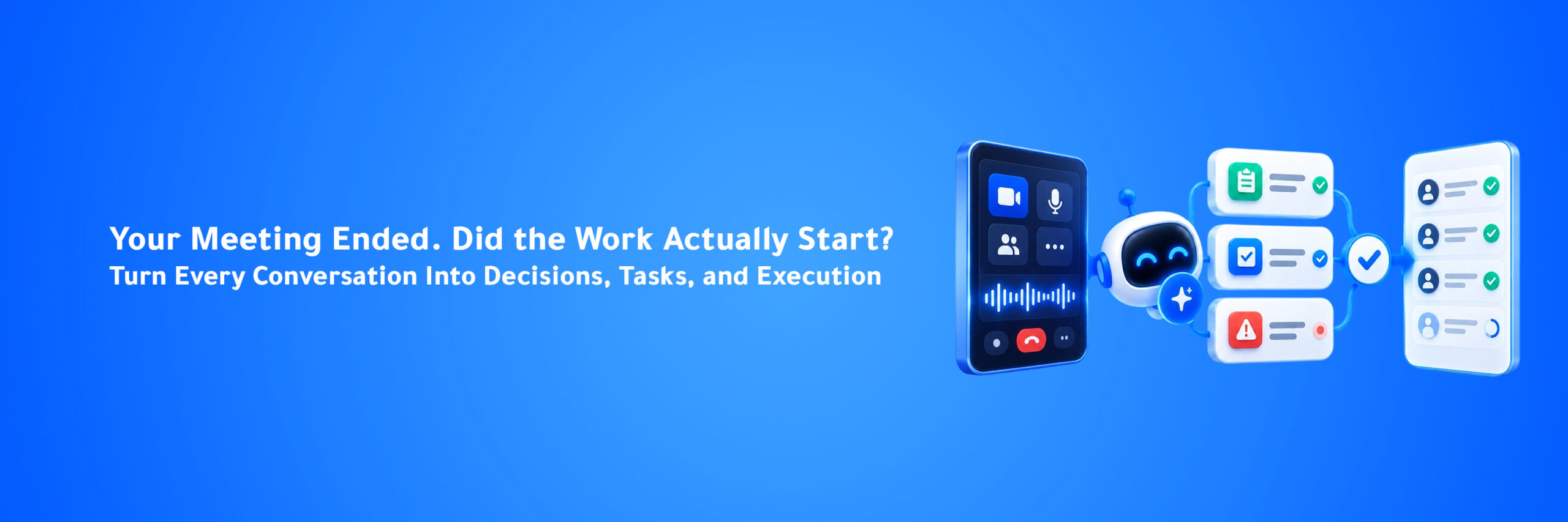
This is the Meeting Execution Gap, and AI can help close it. With AI Meeting Automation, businesses can move beyond recording and transcription toward a connected workflow where conversations become structured meeting minutes, decisions, requirements, action items, approvals, and ultimately tasks that can actually be tracked.
The meeting doesn’t end when people stop talking. That’s when execution begins.
What Is AI Meeting Automation?
AI Meeting Automation uses artificial intelligence and workflow automation to capture, analyze, organize, and operationalize what happens during business meetings.
Basic AI meeting tools typically focus on recording, transcription, and summarization. These capabilities are useful, but they solve only the first part of the problem. A business still needs to understand what was decided, what became an actual requirement, what actions need to happen, who should take responsibility, what could block execution, and which actions should actually move forward.
A more complete meeting workflow therefore looks like this:
Meeting → Recording → Transcription → Meeting Analysis → Decisions & Requirements → Action Items → Human Review → Approval → Tasks → Execution
This is the difference between simply documenting a meeting and turning meeting intelligence into an operational workflow.
The Real Problem Isn’t Meeting Notes
Businesses often treat meeting documentation as the main challenge. Employees spend time writing notes, managers struggle to remember what was discussed, and important details can easily be missed.
But imagine a 60-minute customer meeting ends with five important actions. The salesperson needs to send a proposal, the technical team needs to verify an integration, the account manager needs to confirm pricing, the customer requested another meeting, and management needs to approve a special requirement.
A perfect transcript doesn’t guarantee any of those things will happen. Neither does a perfect summary. Information is not execution.
In a traditional workflow, a meeting ends, someone saves the recording, another person writes notes, the notes are shared, employees identify their responsibilities, tasks are manually created, and follow-up begins. Every manual transition creates another opportunity for something to disappear.
A decision may never become a task. A requirement may be misunderstood. A deadline may never be recorded. An action may have no clear owner.
AI Meeting Automation is valuable because it helps connect what was said with what actually needs to get done.
Capture Meetings Live or Process Existing Recordings
Before AI can understand a meeting, the conversation needs to be captured. But meetings don’t always happen in the same way, so ConnectGain supports both new meetings and conversations that have already been recorded.
With Live Recording, users can record a meeting directly from ConnectGain. Before starting, they can add basic information such as the meeting name, participants, and location. During the meeting, the recording duration can be monitored, and the session can be paused, resumed, discarded, or completed and submitted for processing through Stop and Process.
For meetings that have already happened, Upload Recording allows users to upload an existing audio recording instead of replaying the conversation and documenting it manually. After adding the meeting information, the recording can be submitted through Upload and Process.
This means the same intelligence workflow can support both current meetings and previously recorded conversations.
Supporting Hybrid Meetings
Modern meetings are not always fully physical or fully remote. Sometimes several people are sitting in the same room while others participate through a call on the same device.
For supported hybrid scenarios, Include Call Audio from This Device can be used to capture call audio alongside the audio in the physical meeting environment. Live recording also requires browser microphone permission.
The objective is simple: capture the full conversation before trying to understand it.
From Audio to Searchable Business Context
Once a live meeting ends or an existing recording is uploaded, processing begins with transcription. Instead of requiring someone to replay a long recording to locate one important statement, the conversation becomes written, searchable, and reviewable text.
After processing, ConnectGain organizes the meeting around three important components: Minutes, Transcript, and Recording.
Each serves a different purpose. The original recording preserves the source conversation, the Transcript provides the detailed written version of what was said, and Meeting Minutes organize the information that matters most.
Transcript vs. Meeting Minutes
The Transcript represents the detailed textual version of the conversation. It becomes useful when someone needs to return to the original context behind a decision, requirement, or action.
For example, if the meeting minutes indicate that a customer requested changes to the implementation plan, a manager may want to understand exactly what the customer requested and how the team responded. Instead of replaying the entire recording, they can review the relevant part of the transcript.
Meeting Minutes, on the other hand, turn the conversation into a structured business summary. They can include a summary of the meeting, attendees, agenda or topics discussed, and the important points from the discussion.
The distinction is simple: Transcript tells you what was said. Meeting Minutes tell you what mattered.
Extracting Decisions and Requirements
Meetings frequently produce important decisions, but those decisions can easily become buried inside long conversations. Someone may say, “Let’s move forward with option B,” and the meeting continues for another 30 minutes.
ConnectGain can organize detected Decisions separately so teams have a clearer view of what was actually agreed. This becomes particularly valuable when several departments participate or when a single meeting produces multiple decisions.
The same principle applies to Requirements. A team may discuss many possible ideas, but only some become actual requirements. Organizing requirements separately helps distinguish between what was discussed and what became required, while preserving the surrounding meeting context for review.
Turning Meeting Conversations Into Action Items
This is where meeting intelligence starts becoming operational.
During almost every productive meeting, people agree to do things: send a proposal, contact a customer, prepare a document, verify an integration, update a design, review a contract, or schedule another meeting.
ConnectGain can identify these commitments and organize them as Action Items, including relevant details such as the action itself, priority, and surrounding context.
But there is an important distinction: detecting an Action Item does not mean immediately turning it into an executable task.
Meetings contain brainstorming, suggestions, changing opinions, and hypothetical ideas. An AI system may also need human confirmation that it interpreted the conversation correctly. That’s why ConnectGain adds a review and approval workflow before meeting outputs become operational work.
Capturing Risks, Blockers, and Important Notes
Good meeting intelligence shouldn’t capture only what the team plans to do. It should also preserve what could prevent that work from happening.
ConnectGain can organize Risks, Blockers, and Notes that emerge during the meeting. A dependency may not be ready, a technical limitation may exist, the customer may still need to approve something, or another team may need to complete work first.
This creates a more realistic picture of the meeting. Teams don’t only know what needs to happen; they can also preserve context about what might prevent it from happening.
Human Review Before AI Becomes Action
One of the most important principles behind the Meetings workflow is that AI-generated outputs are not automatically treated as approved business actions.
After analysis, the meeting begins in Draft status. At this stage, users can review the generated meeting information and modify the relevant editable content. Available functions can include Edit, Regenerate, Share, and Export PDF.
This creates a deliberate Human-in-the-Loop model. AI handles the repetitive intelligence work of transcribing, summarizing, organizing, and extracting information, while people retain control over what becomes official.
Once the outputs have been reviewed, the user can select Mark Final, moving the meeting from Draft → Final.
Importantly, Final does not mean executed. It means the meeting output has completed its preparation and review stage and is ready for the next governance step.
Approval Before Execution
After a meeting becomes Final, it can move into Approvals. The responsible manager or authorized reviewer can examine the meeting outputs—particularly the actions that may create operational work—and choose to Approve or Reject them.
If the output is rejected, those actions do not proceed into execution. If approved, the relevant Action Items can move forward into Tasks.
This creates an important layer between AI interpretation and business execution. Instead of allowing AI to automatically turn everything mentioned during a conversation into work, ConnectGain combines AI intelligence with human judgment.
The model becomes:
AI Intelligence → Human Review → Approval → Automated Execution
From Approved Action Items to Tasks
Once Action Items are approved, they can move into the ConnectGain Tasks workflow. This is where the meeting stops being documentation and starts becoming execution.
A task can contain operational information such as Task Name, Description, Priority, Due Date, Assignee, and Status. Teams can then follow these tasks through the available task management experience, including search, filters, overdue monitoring, and List or Calendar views where available.
Instead of a meeting ending with a vague statement like “someone needs to follow up,” the outcome can become a structured task that makes it clear what needs to happen, who owns it, when it is due, and what its current status is.
The Complete Meeting-to-Execution Workflow
The full ConnectGain journey can be summarized as:
Live Meeting / Uploaded Recording → AI Transcription → Meeting Minutes & Analysis → Decisions & Requirements → Action Items → Risks, Blockers & Notes → Human Review → Draft → Final → Approval / Rejection → Approved Action Items → Tasks → Assignment → Execution & Follow-Up
This workflow can be understood through four core layers:
Capture: Record a meeting live or upload an existing recording.
Intelligence: Generate transcription and structured meeting outputs, including decisions, requirements, action items, risks, blockers, and notes.
Governance: Keep the meeting in Draft for human review, move it to Final when ready, and require Approval or Rejection before actions proceed.
Execution: Convert approved Action Items into tasks with ownership, priority, deadlines, status, and ongoing follow-up.
That’s what separates the capability from a basic meeting transcription tool.
From Meeting Notes to Meeting Operations
A traditional AI meeting tool may follow a relatively simple journey:
Meeting → Recording → Transcript → Summary → Done
ConnectGain continues beyond that point:
Meeting → Transcript → Analysis → Decisions → Requirements → Action Items → Review → Approval → Tasks → Execution
The difference is not simply that one workflow contains more AI features. The business outcome is different.
One helps the team remember what happened. The other helps the team act on what happened.
ConnectGain: Turning Meetings Into Actionable Workflows
This is the approach behind Meetings in ConnectGain. Instead of treating meetings as isolated recordings, ConnectGain connects capture, intelligence, governance, and execution in the same workflow.
A meeting can begin through Live Recording or an uploaded recording. The conversation is then transcribed and analyzed into structured outputs such as Meeting Minutes, Decisions, Requirements, Action Items, Risks, Blockers, and Notes.
Users can review the AI-generated output while the meeting remains in Draft. Once the information is ready, the meeting can move to Final and enter the Approval workflow. Approved Action Items can then become Tasks that are assigned and followed through execution.
So the positioning shouldn’t simply be:
“ConnectGain records and summarizes meetings.”
The stronger value is:
“ConnectGain turns meetings into an actionable workflow—from recording and AI analysis to human approval, task assignment, and execution tracking.”
One Meeting. One Connected Workflow.
Imagine a customer implementation meeting where the customer requests three changes, the technical team identifies a blocker, the account manager promises updated documentation, and the project manager agrees to schedule another meeting.
Traditionally, those outcomes could become scattered across the recording, personal notes, email, WhatsApp, task management tools, and employee memory.
With a connected meeting workflow, the recording can become a transcript, the customer’s requirements can be extracted, the technical blocker can be documented, Action Items can be identified, and the team can review the output before it becomes Final.
A manager can then approve the relevant actions, approved work can become Tasks, owners can be assigned, and execution can be tracked.
One meeting becomes one connected path from conversation to action.
Why This Matters for Managers, Teams, and Customers
Managers don’t necessarily need more recordings. They need clarity about what the team decided, what customers requested, which actions need to happen, who owns them, what could block execution, and what remains incomplete.
Employees benefit because they don’t have to rely entirely on memory after several meetings in the same day. AI can help surface commitments while employees focus more attention on the actual conversation.
Customers feel the impact too. When meeting outcomes are poorly documented, customers often have to repeat requests or remind businesses about previous commitments. A structured workflow preserves the context and connects it with the work that follows.
Ultimately, meetings should create accountability. Statements such as “we’ll look into it” or “someone will follow up” sound productive but don’t define execution. A stronger workflow connects each approved outcome with an action, owner, priority, deadline, and status.
The Future of Meetings Is Not Better Notes
AI has already made meeting transcription and summarization easier. But that is increasingly becoming only the beginning.
The larger opportunity is connecting meeting intelligence with business execution. Decisions become visible, requirements become documented, actions become reviewable, approved tasks receive owners, deadlines become trackable, and blockers remain part of the operational context.
AI does not need to replace the human meeting. People still need to talk, listen, think, negotiate, and decide. AI can handle more of the work around those conversations—capturing, transcribing, structuring, and extracting information—while humans review and approve what matters and automation connects approved outcomes with execution.
The meeting stops being an isolated event. It becomes the beginning of a workflow.
Conclusion
Businesses don’t have meetings because they want transcripts. They have meetings because something needs to happen afterward.
A decision needs to be made, a customer needs something, a problem needs to be solved, a project needs to move, a salesperson needs to follow up, or a team needs to execute.
That is why the real value of AI Meeting Automation is not simply understanding what people said. It’s connecting the conversation with what happens next.
With ConnectGain Meetings, businesses can move from live or uploaded recordings to transcription, structured Meeting Minutes, Decisions, Requirements, Action Items, human review, approvals, and ultimately Tasks that can be assigned and tracked.
The complete journey is:
What was said → What was decided → What needs to happen → Who should do it → What actually gets tracked.
Because a successful meeting isn’t one with perfect notes. It’s one where the right work gets done afterward.
Ready to Turn Meetings Into Execution?
ConnectGain by Appgain helps businesses transform meetings into structured, actionable workflows. Capture live meetings or upload existing recordings, generate transcripts and intelligent meeting minutes, extract decisions and action items, review AI-generated outputs, approve the work that should move forward, and turn approved actions into trackable Tasks.
Don’t just record what happened. Make sure what happens next gets done.
WhatsApp: +20 111 998 5526
Website: appgain.io
Email: He***@*****in.io
About Appgain
Appgain is an Agentic AI company helping businesses connect customer conversations, meetings, CRM data, voice, and operational workflows. Through ConnectGain, organizations can use AI to turn conversations into structured business intelligence and connect that intelligence with human review, approvals, tasks, and execution.
ConnectGain by Appgain — AI That Works Where Your Business Works.